🔥 Early access
EU Smart Router: cut AI coding costs by 60%
Send every request to the model that fits the task best, without overpaying for simple work and compromising on complex-work quality.
- Optimize AI costs on every request
- Route for quality that fits the task
- Faster responses, fewer outages
Chosen by leading engineering teams

See how Smart LLM Router can slash your coding agents costs
Benefits of Smart
LLM Router
for your business
Smart LLM router replaces a single default model – cutting your costs, reducing failed requests, and eliminating the engineering overhead of hand-built routing logic.
Cut costs, not quality
Many LLM workloads vary in complexity – some requests genuinely need a frontier model, and the rest can be handled fine on a lower-cost one. Smart router draws that line automatically, so you stop paying premium prices for routine work.
Improve reliability and performance
Smart LLM router directs requests based on model performance and availability. If a model slows down or becomes unavailable, traffic can shift to another option, helping maintain faster responses and fewer failed requests.
No routing logic to build or maintain
Connect to the nexos.ai Gateway and routing is handled for you. No custom logic to write, test, or keep in sync across multiple providers. As your model stack grows, Smart router scales with it automatically.
Continuous learning
The routing system gets smarter over time, learning from new patterns and adapting as tasks, workloads, and model capabilities evolve. This helps keep routing decisions effective as new models emerge and performance changes, without constant manual tuning.
nexos.ai gives Smart LLM Router a real-world proving ground
71%
Reduction in total LLM costs
Smart Router assessed every coding agent request and routed it to the best-fit model from an approved pool. No workflow was disrupted and nothing else had to change.
Smart LLM Router is more than choosing the cheapest model
84%
of coding traffic can be routed to an open-weight models, while frontier models stay ready for the hard calls.
Routing on price alone creates trade-offs. A cheaper model can lose quality on complex tasks, and switching models unnecessarily breaks prompt caching, forcing the same context to be reprocessed from scratch.
Smart LLM router accounts for the whole request – task complexity, model capability, cost, performance, and cache efficiency together, not cost in isolation.
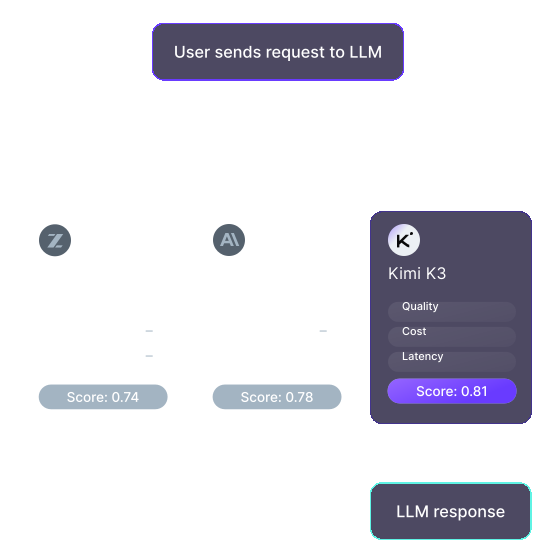
How does nexos.ai
Smart LLM Router work
Smart LLM router is built directly into the nexos.ai
Smart LLM Router
use cases
Here's where smart router makes the biggest difference – the patterns teams put into production first.
Coding agents and developer tooling
Coding agents generate a huge request volume, ranging from routine lookups to complex reasoning. Smart router matches each task to the right model tier – without the unnecessary model switching that can hurt prompt
Customer support and chat triage
Support requests range from simple lookups to complex troubleshooting. Smart router sends routine questions to fast, cost-efficient models and reserves stronger models for requests that need deeper reasoning. Response times drop on the easy questions, and quality holds where it matters.
Agentic workflows and multi-step automations
A single AI workflow can involve many steps, from extracting data and calling tools to planning and complex reasoning. Smart router matches each step with the right level of model capability, so you don't run the entire workflow on your most expensive model.
Compliance-sensitive routing
Apply routing rules to keep sensitive requests within approved models, providers, or regions, while everything else routes freely on cost, task complexity, quality, or speed.
Security and compliance, built in
EU-resident inference
AI requests are processed throughZero data retention
Supported models do not retain prompts or responses after delivery.OpenAI SDK compatible
Switch in minutes with minimal code changes.Automatic failover
One provider goes down, traffic reroutes automatically.Smart LLM router
vs one default model
Running every request through a single model is the simplest setup – but it means paying the same price whether the task needs it or not.
nexos.ai Smart LLM router
Single default model