Smart Router: How Nord Security cut AI coding costs by 71%
nexos.ai validated Smart Router on Nord Security’s production coding-agent traffic. Here’s how mixing frontier and open-weight models reduced costs without changing a single prompt, agent, or developer workflow.
Reduction in LLM costs
Tokens processed
Workflow changes required
Nord Security overview
One of Europe’s leading cybersecurity companies, building security and privacy products used by millions of people and businesses worldwide. Its portfolio includes globally recognized products such as NordVPN, NordPass, NordLayer, NordLocker, and Saily.
25M+
Users protected
$3B
Company valuation
2000+
people
Where nexos.ai comes in
The Challenge
Why the simplest tasks
became the most expensive
Nord Security’s engineering teams primarily used Claude Opus 5 for coding-agent tasks ranging from routine code changes and documentation to complex debugging and software architecture.
Because coding agents make repeated LLM calls with growing context, costs increased quickly as usage grew, even though many tasks didn’t require a frontier model. Nord Security began exploring task-level routing to reserve frontier capabilities for complex work and route routine requests more efficiently.
Premium model overuse
Routine and complex tasks were processed at the same premium-model price.
Increasing cost per session
Repeated calls and growing context increased the cost of every coding session.
Routing complexity
Building and maintaining task-level routing internally would require additional engineering work.
Lack of visibility
Without a central layer, it was difficult to track which tasks or teams were driving the most spend.
A tiered model strategy for every coding request
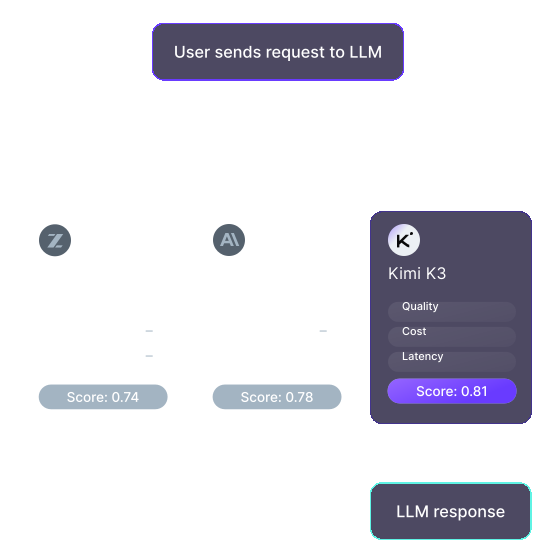
Nord Security routed coding-agent traffic through the nexos.ai AI Gateway with built-in Smart Router. Rather than defaulting every request to one provider, the gateway matched routine, intermediate, and complex tasks to the right model for the engineering team.
Smart router by complexity
Each request was evaluated for reasoning depth and capability needs, then routed to the most cost-efficient model. Claude Opus 5 was reserved for the hardest tasks, while faster models handled simpler work.
Cache-aware routing
Routing decisions were made at natural task breakpoints rather than mid-flow, helping maintain cache efficiency. This reduced unnecessary recomputation, kept repeated context from being reprocessed, and improved the overall cost efficiency of long running coding workflows.
Automatic fallback
If a model hit an error, timed out, or could not complete the request, the gateway automatically sent it to another appropriate model. This added resilience to the setup and helped engineers keep working without interruptions.
Frontier capabilities without frontier costs
By using the right model for every request, Nord Security stopped overpaying for routine tasks while retaining top-tier reasoning. This shift turned a growing cost center into a sustainable, high-performance operation that scales with their needs.
Lower LLM costs
Tokens processed
Higher spend with Opus only
