LLM caching that optimizes AI costs
Stop building separate caching logic for every provider. nexos.ai simplifies LLM caching through one integration, so your team can focus on building products.
Lower token costs – skip reprocessing repeated context.
Faster responses – return cached responses with lower latency.
One integration – no per-provider cache logic to maintain.
Chosen by leading engineering teams

What is LLM caching?
LLM caching stores and reuses previously processed prompts or responses. When identical or similar queries share a system prompt or repeated prompt prefixes, the LLM caching system returns a stored response instead of recomputing it – fewer redundant computations, lower token costs, faster responses.Contexts commonly cached
This is especially useful for AI applications that repeatedly send large blocks of shared context, from API-driven agents to an AI workspace for multiple LLMs, such as:Benefits of LLM caching
Save engineering time
nexos.ai, an all-in-one AI platform, centralizes provider-specific caching implementations behind one integration, so your engineers spend less time maintaining it and more time building products.
Reduce AI costs
A higher cache hit rate means less repeated context to reprocess and fewer input tokens to pay for, direct savings on every cached query, alongside the Gateway'sImprove response times
On a cache hit, nexos.ai returns the stored response directly, no call to the model, no generation time. This matters most for requests with large repeated context.Scale AI without rebuilding caching
Caching gets harder to manage with every new agent, model, or provider you add. nexos.ai keeps it working through one integration, so it scales with your stack, no rebuild, no lock-in.How nexos.ai improves LLM caching
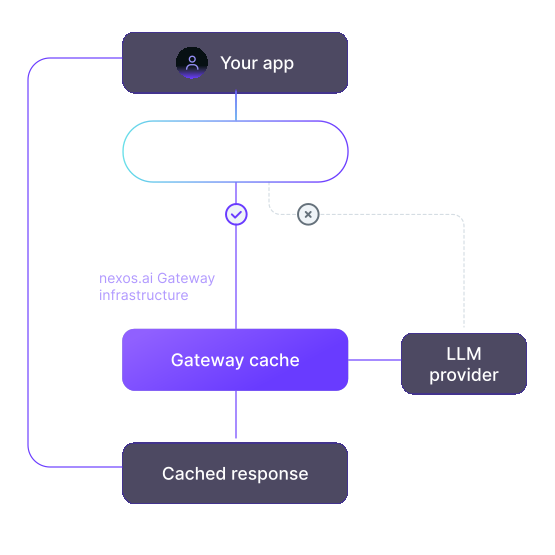
nexos.ai works on two levels. Exact repeats are answered instantly by the Gateway's own cache, no provider call needed. Everything else is structured to make the most of the provider's own caching, so nothing gets processed at full price unnecessarily.
No workflow changes
Developers keep using the same models, prompts, coding agents, and applications. Caching improvements happen through the Gateway underneath, so cost savings show up without redesigning how your team works.
Catch missed opportunities
Repeated context still gets processed at full price when caching is missing or misconfigured. nexos.ai helps identify repeated context and improve how effectively provider-side prompt caching is applied.
Handle provider differences
Providers differ in how prompt caching is enabled, structured, and reported. nexos.ai manages those differences through one centralized integration, so you don't build a separate caching system for every provider.
Stay effective as you scale
New agents, changing prompts, and updated workflows can erode cache effectiveness over time. Centralized visibility helps teams monitor cache hit rates and keep caching working as AI usage grows.
Two ways nexos.ai makes caching work
Caching saves money in two different places: at the Gateway and inside the provider. nexos.ai handles both, so you get the benefit either way. Here's how:
Response caching
The Gateway keeps its own cache of past requests and responses. When an identical request comes in again, nexos.ai returns the stored response directly, with no call to the provider at all. This is the fastest possible outcome: no generation, no wait, no cost.
Prompt caching
Prompt caching lives on the provider's side, reusing repeated prompt prefixes, like a shared system prompt, so requests that begin the same way skip reprocessing. nexos.ai makes sure your requests are structured to take full advantage of it, so you capture these savings without extra work.
The complexity of
LLM caching
Provider caching isn't "set and forget." It happens at the AI provider level, but keeping it effective is an ongoing job. Each provider has its own rules, so teams typically need to:
Configure parameters correctly
Small misconfigurations quietly kill your cache hit rate.Validate cache hit rates
Confirm caching is actually firing, not just assumed.Optimize prompts
Structure requests so repeated context is cacheable in the first place.Maintain it across providers
Then do it all again for the next model.How nexos.ai tackles
these challenges
nexos.ai turns caching from a per-provider chore into one integration your team sets up once. Instead of administering caching model by model, the nexos.ai Gateway manages it centrally, giving you visibility into cache effectiveness across every provider from one place.
Less implementation work
No provider-specific caching to build and maintain for every model.
Savings you can actually see
See exactly how many tokens, and how much cost, caching saved you.
Spot problems early
Hit-rate data flags misconfigurations before they cost you savings.
No new setup per provider
Connect a new provider without building separate caching logic for it.
Scales without extra setup
Add new agents, models, or providers without adding new caching work.
Real-world results
of LLM caching
Nord Security is cutting costs and improving cache performance for their coding agents running on nexos.ai, without changing how their teams work. And the results speak for themselves:
FAQ
Yes. nexos.ai is model-agnostic by design, so caching applies across the different providers you connect through a single Gateway. Instead of managing caching provider by provider, you route your requests through one integration and let nexos.ai maximize cache hits across supported large language models, capturing savings across your entire AI stack rather than one model at a time.
Partly – nexos.ai has its own AI Gateway cache that catches exact repeats before a request ever reaches the provider, on a hit, there's no call to the provider at all.
The AI gateway keeps its own cache of past requests and responses.
Not with nexos.ai. Normally, each provider caches on its own terms, which means teams end up configuring, and maintaining a different implementation for every model they use – then repeating that work for each new provider. nexos.ai removes that overhead. One integration with the Gateway handles caching across supported providers automatically, so your engineers don't need to manage it at all.
LLM caching works across every model connected through the nexos.ai Gateway; support isn't limited to what each provider offers. The Gateway has its own cache that stores and returns responses independent of the provider, so caching works regardless of whether the underlying model supports it. Where providers do offer their own caching, nexos.ai takes advantage of that too, all managed through the same integration.
No. Developers don't need to rearchitect their applications or build provider-specific caching logic. Your requests keep flowing through the same single endpoint they always have, and nexos.ai handles caching underneath, so the cost savings and faster responses show up without any workflow changes. It's the same experience Nord Security had: better caching, zero changes required.
Yes. Caching happens within each provider's secure infrastructure, and nexos.ai never uses your data to train models. Cached requests are covered by the same protections as every other call through our platform for AI security.