Table of contents
What are AI agents for ecommerce?
AI agents are autonomous software systems that perceive their environment, make decisions, and take actions to achieve specific goals. In ecommerce, they're built on large language models (LLMs) and trained to execute tasks like answering customer support tickets, personalizing product recommendations, or adjusting inventory levels without constant human intervention.
Unlike traditional automation that follows rigid if-then rules, different types of AI agents learn from data and adapt to context. They understand natural language, process unstructured inputs, and make judgment calls. When a customer asks, "Do you have running shoes for pronation in size 10?" an AI agent doesn't just search keywords. It interprets the medical term, checks inventory across warehouses, and suggests alternatives if that exact SKU is out of stock.
Key use cases of AI agents in ecommerce
Your store generates thousands of micro-decisions daily. AI agents for ecommerce handle the repetitive ones, so your team focuses on strategy, creative work, and high-value relationships.
Personalized product discovery and recommendations
Generic "you might also like" carousels convert very low. Ecommerce AI agents analyze browsing behavior, purchase history, and real-time context to surface products each customer actually wants. They factor in seasonality, local trends, and individual preferences simultaneously.
A fashion retailer using AI-powered recommendation agents saw higher click-through rates and a boost in average order value. The agent identified that customers who browsed winter coats on mobile during lunch hours had different purchase intent than desktop evening browsers and adjusted recommendations accordingly.
Customer service and support
Your customer support agents drown in repetitive questions about shipping, returns, and product specs. Ecommerce AI agents resolve most of tier-1 inquiries instantly. They pull order status from your OMS, check return eligibility against your policy database, and explain product features using data from your PIM, all in natural conversation.
When escalation is needed, the agent hands off full context to human agents. No "let me pull up your account" delays. An electronics retailer could cut first-response time from hours to seconds and reduce customer support costs.
Inventory management and demand forecasting
Stockouts cost you sales. Overstock ties up capital. Ecommerce AI agents ingest sales velocity, seasonal patterns, supplier lead times, and external signals like weather or local events to predict demand at SKU-level granularity.
A home goods brand deployed forecasting agents that reduced excess inventory while cutting stockouts. The agents automatically triggered purchase orders when predicted demand crossed reorder thresholds and suggested markdowns for slow-moving SKUs before they became dead stock.
Dynamic pricing and promotions
Static pricing leaves money on the table. Ecommerce AI agents monitor competitor prices, inventory levels, conversion rates, and customer segments to adjust prices dynamically. They run thousands of micro-tests simultaneously, testing different price points for different cohorts, and optimize toward your goals: revenue maximization, margin protection, or inventory clearance.
An outdoor gear retailer's pricing agent increased gross margin. It identified that loyal customers were price-insensitive on technical gear but discount-driven on accessories, then personalized pricing accordingly within legal and ethical bounds.
Agentic commerce: the autonomous shopping journey
Out of many agentic AI use cases, agentic commerce takes ecommerce AI agents beyond single tasks. Here, multiple AI agents orchestrate the entire customer journey. A discovery agent surfaces relevant products. A consultation agent answers questions and offers styling advice. A transaction agent handles checkout, applies optimal discounts, and confirms delivery preferences.
The customer experiences one seamless conversation. Behind the scenes, specialized agents collaborate by pulling data from your product catalog, CRM, inventory system, and payment gateway. A luxury watch retailer reported that it implemented agentic commerce and saw fewer cart abandonments. Customers completed purchases faster than through traditional checkout flows.
Benefits of AI agents for ecommerce businesses
AI agents for ecommerce deliver measurable business impact across operations, customer experience, and revenue. Here's what changes when you deploy them effectively.
Personalization at scale
You can't manually personalize experiences for 50,000 monthly visitors. Ecommerce AI agents can. They tailor product displays, messaging, and offers to each customer's context in milliseconds. The result: higher engagement, more repeat purchases, and stronger customer lifetime value.
Reduced operational costs
Hiring customer support agents for 24/7 coverage costs hundreds of thousands annually. Ecommerce AI agents handle overnight shifts, holiday surges, and routine inquiries at a fraction of the cost. Your human team focuses on complex issues, relationship-building, and strategic initiatives that actually grow the business.
Higher conversion rates
Generic product pages convert at lower rates than AI-personalized experiences. Ecommerce AI agents remove friction by predicting what customers need and surfacing it proactively. They answer objections before customers abandon carts and suggest complementary products at the right moment.
24/7 availability
Your customers shop at 2 AM. Your best customer support agent doesn't work then. Ecommerce AI agents do. They maintain consistent service quality across time zones and traffic spikes. Black Friday at 11 PM? The agent handles it without overtime pay or burnout.
Faster decision-making
Your pricing team reviews competitor data weekly. Ecommerce AI agents monitor it in real time and adjust instantly. Your merchandising team for ecommerce sites can plan promotions months aheadthanks to informed decisions delivered by artificial intelligence. Agents identify trending products daily and surface them while demand is hot. Speed creates competitive advantage. This process can revolutionize online shopping and help ecommerce businesses and online retailers boost sales and operational efficiency in many sales channels with AI tools.
Improved customer satisfaction
Customers hate waiting. Ecommerce AI agents respond in seconds, resolve issues in one interaction, and remember past conversations. Beauty brands report higher customer satisfaction with AI-assisted support compared to human-only models, driven by faster and more consistent responses.
These benefits compound. AI systems for ecommerce deliver personalized shopping experiences, which drive conversion. Higher conversion reduces acquisition costs. Lower costs fund more AI investment. The gap between early adopters and those who won’t catch up widens quarterly.
Challenges of implementing AI agents in ecommerce
AI agents for ecommerce aren't plug-and-play. You'll face these obstacles:
- Data quality and fragmentation: Your product data lives in Shopify. Customer data in HubSpot. Inventory in NetSuite. AI agents in ecommerce need unified, clean data to function. If your product descriptions are inconsistent or your inventory counts are stale, agents will fail or worse, hallucinate incorrect information. Expect a few weeks of data cleanup before deployment.
- Privacy and compliance: Ecommerce AI agents process personal data, such as purchase history, browsing behavior, and customer support conversations. You're responsible for GDPR, CCPA, and PCI compliance. If your agent leaks customer data or uses it improperly, you face legal consequences and reputational damage. AI security risks multiply when agents access sensitive systems.
- Over-automation risks: Not every interaction should be automated. High-value customers expect personalized human attention. Complex complaints require empathy and judgment. If you automate indiscriminately, you'll frustrate your best customers and damage relationships worth tens of thousands in lifetime value.
- Governance and visibility: When 15 different teams deploy ecommerce AI agents independently, you lose control. Marketing runs one chatbot. Support runs another. Sales builds a lead qualification agent. You have no centralized view of what's running, who's using it, or how it performs. This "shadow AI" creates security gaps, duplicated costs, and conflicting customer experiences. AI governance isn't optional at scale.
These key challenges are solvable. Treat them as prerequisites, not blockers. The teams that solve for data quality, governance, and compliance first move faster and deploy more confidently than those who rush to production and fix problems later.
How to choose the right AI agent for your ecommerce business
Choosing an ecommerce AI agent isn't about finding the 'best' solution. It's about matching capabilities to your specific context, constraints, and goals. Use this framework to evaluate options systematically.
1. Define your primary use case
Don't build AI for AI's sake. Identify your biggest operational bottleneck or revenue opportunity. Are you drowning in support tickets? Start with a customer service agent. Losing sales to stockouts? Prioritize demand forecasting. Conversion rate stuck below 3%? Deploy personalization agents.
Measure current performance. If your support team handles 800 tickets weekly at an average resolution time of 6 hours, you have a baseline. Deploy an agent, track deflection rate and customer satisfaction, and calculate ROI in weeks, not months.
2. Evaluate tech stack compatibility
Your ecommerce AI agent must integrate with existing systems. Does it connect to your ecommerce platform (Shopify, BigCommerce, Adobe Commerce)? Can it pull structured data from your CRM, inventory management system, and analytics tools via APIs?
Avoid agents that require full platform migrations. Look for API-first architectures that slot into your current infrastructure. Ask vendors for integration timelines and technical requirements upfront.
3. Assess data readiness
AI agents in ecommerce are only as good as your data. Audit what you have:
- Product data: Complete descriptions, accurate attributes, consistent categorization;
- Customer behavior data: Unified profiles across touchpoints, consent records, segmentation;
- Operational data: Real-time inventory counts, order statuses, shipping information.
If your data is fragmented or low-quality, pause agent deployment and fix your data foundation first. Garbage in, garbage out.
4. Consider governance and oversight
You need visibility into what your ecommerce AI agents do. Choose solutions with built-in LLM observability that log every customer interaction, track response quality, and surface anomalies. When an agent starts hallucinating or costs spike unexpectedly, you need to know immediately to involve human oversight.
Establish clear approval workflows. Who can deploy new agents? Who reviews outputs before they go live? How do you audit agent behavior retroactively? Answer these questions before your first deployment, not after something goes wrong.
5. Plan for multi-LLM flexibility
No single LLM excels at every task. GPT-5 might handle complex customer inquiries better. Claude could generate more nuanced product descriptions. Gemini might offer better cost-performance for simple classifications.
Avoid vendor lock-in. Use platforms that support AI orchestration across multiple LLM providers. You want the flexibility to route different workloads to different models based on performance, cost, and capability without rebuilding your entire agent infrastructure.

Build no-code AI Agents in minutes
Move from chatting with AI to getting things done.
Chat with leading AI models
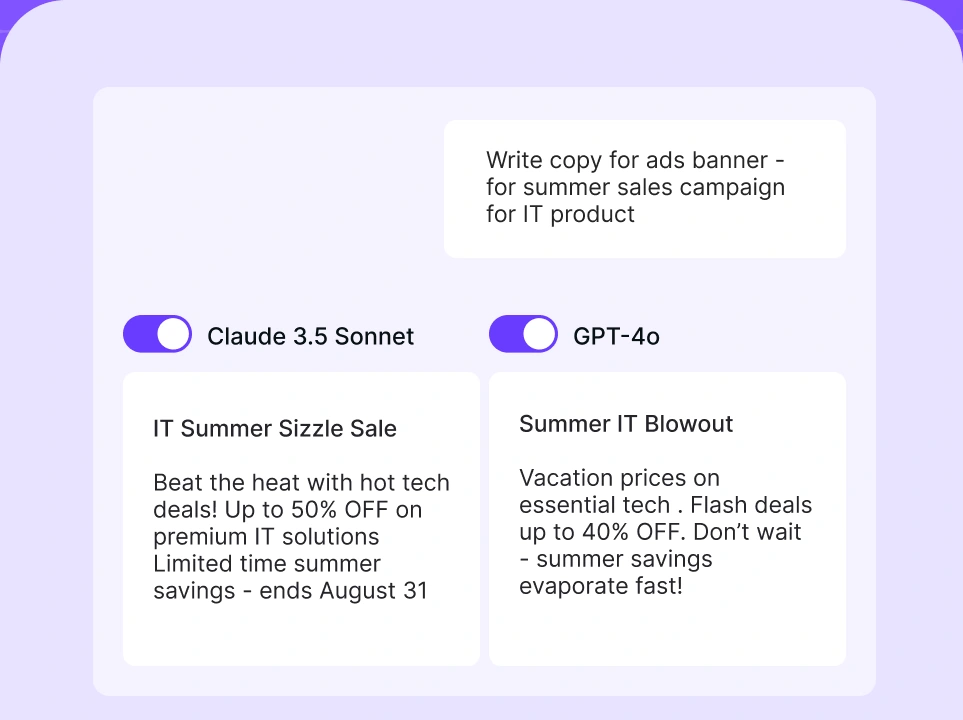
Compare AI models
Build no-code AI Agents

6. Start small, scale strategically
Don't automate your entire operation on day one. Pick one high-impact, low-risk use case. Deploy a customer service agent for FAQs only. Run a pricing agent on 10% of your catalog. Test, measure, refine.
Once you prove ROI and iron out edge cases, expand gradually. Add more use cases, increase coverage, and connect agents to orchestrate multi-step, complex workflows. This phased approach minimizes risk and maximizes learning.
The right ecommerce AI agent isn't the one with the most features or the flashiest demo. It's the one that integrates smoothly, solves your specific problem, and gives you the control to scale safely.
How nexos.ai helps you manage AI agents for ecommerce
nexos.ai provides the unified orchestration and governance layer ecommerce businesses need to deploy AI agents effectively, without vendor lock-in or shadow AI sprawl.
Multi-LLM orchestration: Run and manage agents within one workspace across multiple LLMs, such as OpenAI, Anthropic, and custom models from one platform. Route customer inquiries to Claude, product descriptions to GPT-5, and sentiment analysis to a fine-tuned open-source model, all from a single interface. Switch providers instantly if performance degrades or costs spike.
LLM observability: Monitor agent performance, response quality, and cost in real time across all deployments. Track which agents generate the most value, which burn through tokens inefficiently, and which produce hallucinations. LLM observability gives you the real-time data to optimize continuously.
AI governance: Centralized visibility into which AI agents are running, who deployed them, and how they perform. Marketing can't accidentally launch a chatbot that contradicts Support's messaging. IT maintains control without slowing down business systems. AI governance eliminates shadow AI risk while enabling rapid experimentation.
Enterprise security: SOC 2 Type II compliance, ISO 27001 certification, end-to-end encryption, and granular access controls built for enterprise ecommerce environments. Your customer data never trains third-party models. Audit logs capture every agent interaction. You meet regulatory requirements without compromising agent capabilities.
Try nexos.ai's all-in-one AI platform to orchestrate and govern your ecommerce AI agents with enterprise-grade security and observability.