Table of contents
Key takeaways
- AI cost management helps you turn unpredictable AI spend into a controlled, attributable line item, so you can scale usage without scaling waste.
- AI cost governance is usage-based and ongoing, which makes them harder to forecast than one-time software purchases.
- Visibility at the request level is the foundation of any working cost strategy.
- Routing tasks to the right-priced model and caching repeated responses are two of the biggest cost levers you have.
- Gateway-based tools give you real-time control, while billing-based tools only report after the money is gone.
What is AI cost management?
AI cost management is the practice of tracking, budgeting, monitoring, and optimizing the money your organization spends on AI models and services. It gives you a clear view of where AI spend goes, sets limits before costs run over, and finds the cheapest way to get the same quality of output.
In practice, AI cost management covers four things: visibility into spend across every team and model, budgeting so each group knows its ceiling, ongoing monitoring so nothing runs unchecked, and optimization that helps manage costs without hurting results. Most of that spend comes from calls to a large language model, which prices output by volume rather than by seat, so the more your teams use, the more you pay.
AI cost management vs. traditional cloud cost management
AI costs and traditional cloud costs both show up on an invoice, but the forces behind them are different. Cloud spend scales with the infrastructure you provision, while AI spend scales with every prompt your teams send, which makes it far harder to predict. Here is how AI cost management and traditional cloud cost management compare across the factors that matter most:
Factor | AI cost management | Traditional cloud cost management |
|---|---|---|
What drives cost | Tokens processed per request, model choice, and call volume cost tracking | Provisioned compute, storage, and bandwidth |
Pricing model | Pay-per-token, priced separately per model | Pay-per-resource, often with reserved or committed discounts |
Predictability | Low, since cost tracks unpredictable user and agent behavior | Higher, since usage patterns are relatively stable |
Cost attribution | Difficult, spread across teams, models, and providers | Straightforward, tied to named resources and accounts |
Optimization levers | Model routing, caching, prompt efficiency, usage limits | Right-sizing, reserved capacity, autoscaling |
Why AI costs are so hard to control
AI costs are hard to control because they grow with behavior you cannot fully predict and they arrive from many directions at once. Effective AI spend management starts with understanding what actually drives the numbers up. Here are the main cost drivers to watch:
- Token-based pricing. You pay for every token going in and coming out, so a longer prompt or a chattier response quietly raises the bill on every single call.
- Inference as an ongoing cost. Unlike buying software once, running a model is a recurring expense. Every request costs money, and the meter never stops while people keep using it.
- Agentic workflows that multiply calls. A single agentic task can trigger dozens of model calls as the agent reasons, retries, and chains steps, turning one user action into a stack of billable requests.
- Spend fragmented across providers. Teams pull from different providers depending on the task, so your total AI cost sits scattered across multiple invoices with no single view.
- AI usage without central oversight. When individuals sign up for models on their own, spend happens outside any budget, and finance only finds out when the statements arrive.
These drivers stack on top of each other, which is exactly why AI system bills are one of the recurring LLM challenges teams face as they scale AI adoption.
AI cost management best practices
The AI cost management best practices below give you a repeatable way to bring spend under control, from seeing where the money goes to routing tasks to the cheapest capable model. Each one tackles specific AI services, and together they form a system you can actually run.
Get full AI cost visibility
Full AI cost visibility is the foundation of everything else, because you cannot control spend you cannot see. AI usage tracking gives you that by showing how tokens, requests, and costs are distributed across teams, models, providers, and projects. Rather than looking at one lump sum, you can trace spend back to the workloads generating it. Provider invoices alone will not get you there.They show a monthly total per provider with no breakdown of which team ran which model on what, so you are left guessing where the money went and unable to act until the next bill lands.
Set budgets, limits, and real-time alerts
Budgets and limits keep AI costs predictable by capping spend before it runs away, which is the core of good AI cost control. Set limits at different levels, so each team, project, and user has a ceiling that matches its needs. Then wire up real-time alerts that fire as you approach a threshold, not a report that tells you the budget was blown last week. Getting warned before you cross the line means you can pause or reroute usage while it still matches, which is where comparing costs across models pays off. You can compare AI models on price and capability, and approaches like FrugalGPT show how much you save by picking the cheapest model that still clears the bar.
Route each task to the right model
Routing each task to the right model means to allocate AI costs to the job of an appropriately priced model instead of sending everything to the most expensive one. Model prices vary by a wide margin, so this is one of the biggest cost levers available. AI capabilities are never-ending – but a simple task like classifying a support ticket or reformatting text runs perfectly well on a small, cheap model. A complex task like multi-step legal analysis justifies a top-tier model. Defaulting every request to your most powerful option means you pay higher project costs for work a cheaper model would have handled fine.
Cache responses to cut redundant spend
Caching cuts redundant AI spend by storing answers to requests you have already paid for. When the same or a very similar prompt comes in again, you serve the saved response instead of hitting the model and paying for it a second time. Caching improves latency as a side benefit, since a cached answer returns instantly. Picture a customer-facing chatbot fielding the same handful of questions hundreds of times a day. Without caching, every repeat question is a fresh billable call. With it, you pay once and reuse the answer.
Establish AI governance and cost allocation
Governance keeps AI spend accountable over time by assigning clear cost data ownership per team and enforcing usage policies. When each team owns its share of the bill, spend stops being an anonymous company-wide number and becomes something people are answerable for. Usage policies define which models are approved and who can access them, which prevents unsanctioned AI usage from creating invisible costs that never tie back to anyone. You can put this structure in place with AI governance controls that centralize access and policy in one spot.
AI cost management tools: which type do you need?
AI cost management tools fall into two broad categories, and the one you pick shapes how much control you actually get. Billing-based tools report on spend after the fact, while gateway-based tools sit in the request path and act on costs as they happen. Here is how each works and where it fits.
Billing-based tools
Billing-based tools, often called FinOps tools, work from provider invoices after the money has already been spent. They pull in your statements, consolidate them, and give finance a tidy view of total AI spend across providers. That makes them useful for consolidated reporting and month-end accounting. Their limit for AI is that they operate on invoice data, so there is no request-level detail and no way to act in real time. By the time a billing-based tool flags a spike, the spend already happened and cannot be undone.
Gateway-based tools
Gateway-based tools like nexos.ai AI Gateway sit between your applications and AI providers, capturing every request as it happens. Because they are in the live request path, they see request-level detail the instant it occurs and can act on cost right there, applying budgets, routing requests to cheaper models, and serving cached responses, rather than only reporting after the fact. That combination of real-time visibility and real-time control is what makes a gateway the practical foundation for managing AI costs at scale.

Run every AI model in one Gateway
One secure, lightweight layer to access, route, and manage 200+ models.
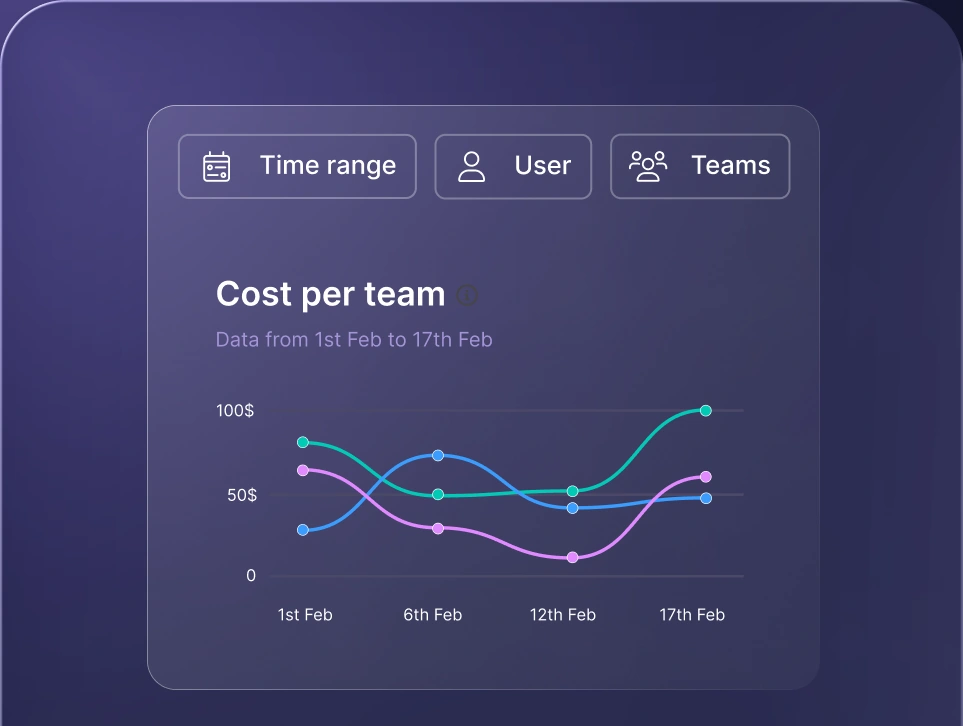
Monitor AI usage
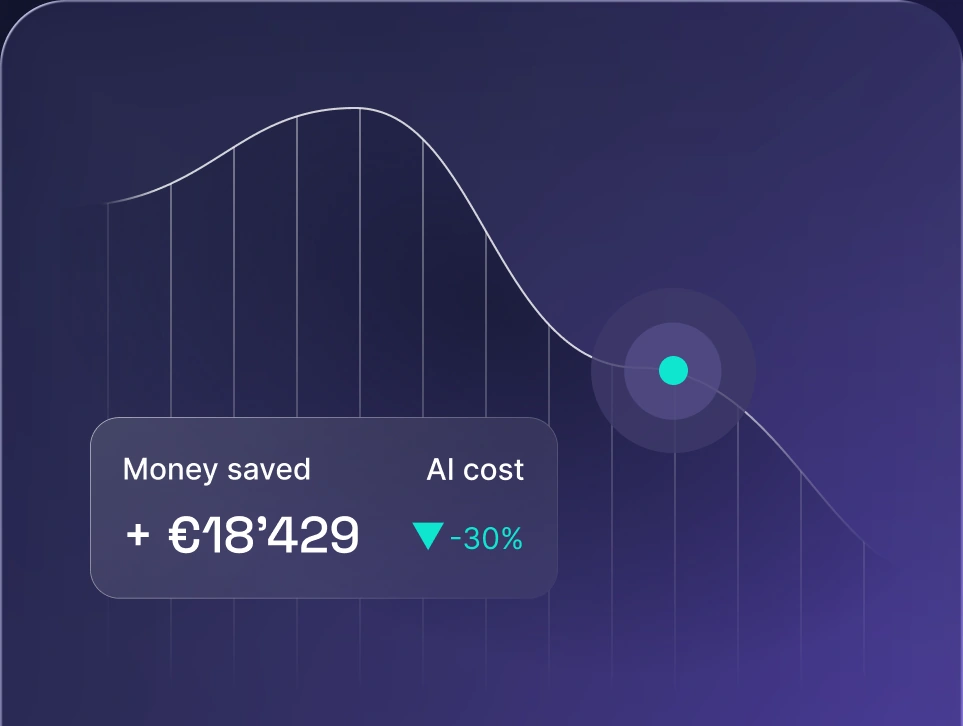
Control AI spend
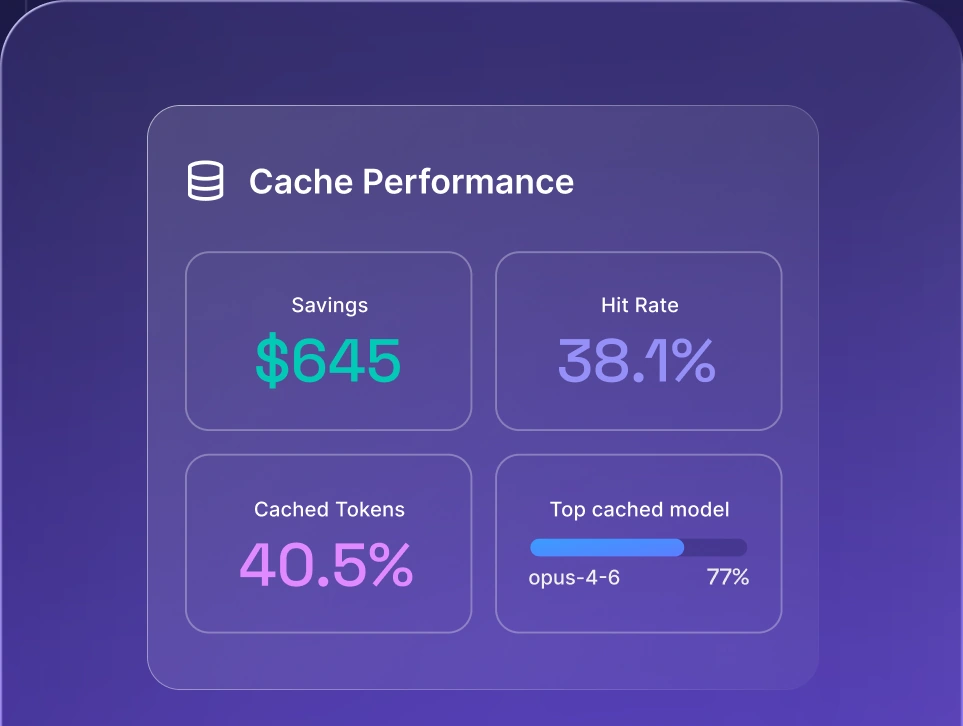
Optimize AI costs

How nexos.ai helps you manage AI costs
nexos.ai provides an enterprise-grade AI gateway that gives you visibility and control over AI powered cost management, tying each capability directly to the cost problems covered above. Instead of stitching together separate reporting and control tools, you get one platform that sees every request and acts on it. Here is how each feature maps to a specific cost challenge:
- AI Gateway with failover and caching routes requests across 200+ AI models, so every task lands on an appropriately priced model instead of your most expensive default. Response caching cuts the redundant spend from repeated requests, and automatic failover protects uptime when a provider goes down.
- LLM observability delivers request-level logging with cost attribution per team, model, and project, which solves the visibility gap that provider invoices leave open.
- AI governance centralizes access controls and usage policies, so only approved models and users generate costs, closing off unsanctioned usage before it turns into invisible spend.
- No-code Agent Builder lets you build agentic workflows with cost visibility built in, so the model calls that agents multiply stay tracked instead of hidden.
- Enterprise security covers SOC 2 Type 1, ISO 27001, and GDPR, so cost control never comes at the expense of compliance.
You can see how it all fits together on the all-in-one AI platform and start turning unpredictable AI bills into spend you actually control.


Run every AI model in one Gateway
One secure, lightweight layer to access, route, and manage 200+ models.
