What are AI governance tools?
AI governance tools are dedicated solutions that manage model compliance, auditability, data integrity, and operational safety throughout the full AI lifecycle. AI governance refers to the combined guardrails, evaluation pipelines, access policies, and audit trails that keep intelligent applications aligned with business intent and legal standards. Modern AI governance software establishes a clear operating model for your team, translating abstract principles into automated policy enforcement and continuous governance.
To understand where this software fits, it helps to distinguish it from adjacent categories across modern enterprise tech stacks:
- MLOps platforms. Infrastructure suites like Kubeflow or MLflow handle model training, deployment pipelines, and compute resources for AI systems. They focus on engineering workflows instead of compliance, policy enforcement, or risk oversight.
- Data catalogs and metadata tools. Platforms like Alation track table lineages and data schemas across enterprise databases. They build a solid data governance foundation, but they don't monitor runtime model behavior, agent actions, or live inference data pipelines.
- General GRC platforms. Legacy governance, risk, and compliance suites track broad IT controls and vendor spreadsheets. They lack real-time inspection for prompt injections, non-deterministic model outputs, and automated risk assessments for every registered AI asset.
- DSPM and CASB tools. Data security posture managers and cloud access security brokers govern sensitive data at rest and inspect generic cloud traffic. They don't evaluate model fairness, bias detection, drift, or agent execution chains.
An enterprise governance platform connects these silos, giving you centralized visibility across your models, datasets, and user interactions.
Why AI governance tools matter now
Scaling intelligent tools without AI governance exposes your organization to severe legal, financial, and operational vulnerabilities. Unmanaged systems introduce significant AI risk, ranging from leaked intellectual property and biased automated decisions to runaway API spending. Adopting dedicated AI risk management tools gives you the visibility needed to reduce AI risk while managing risk effectively across active deployments.
Regulatory pressure has accelerated this requirement across every major market:
- The EU AI Act. Enacted as the world's most comprehensive framework, the EU AI Act phases in strict requirements across 2025 and 2026. High-risk systems must maintain detailed technical documentation, rigorous risk assessments, continuous monitoring, and proven human oversight. Non-compliance carries severe financial penalties up to $38 million or 7% of global annual turnover.
- NIST AI RMF. The NIST AI RMF provides a voluntary yet widely adopted risk management framework structured around four core functions: Govern, Map, Measure, and Manage. Aligning with the EU AI Act, NIST AI RMF, and ISO/IEC 42001 gives organizations an actionable blueprint to meet complex regulatory obligations and strengthen their overarching risk management framework.
- State and global AI bills. Emerging legislative efforts, like state-level AI bills in the United States and international standards like ISO/IEC 42001, mandate continuous risk monitoring, algorithmic accountability, and formal impact assessments for automated decision systems.
Unmonitored deployments create dangerous internal blind spots across everyday workflows. Ungoverned experimentation leads directly to shadow AI, where team members paste proprietary code and confidential company data into unauthorized third-party AI services. Without reliable security policies and automated policy enforcement, organizations face reputational damage, legal liabilities, and uncontrolled cloud bills. Establishing proper AI oversight and automated AI controls helps your organization maintain safety while supporting responsible AI adoption.
Types of AI governance tools
Modern AI governance frameworks fall into several specialized categories, each addressing distinct challenges across the entire AI lifecycle. Most mature organizations combine multiple systems or deploy comprehensive AI governance platforms to maintain effective AI governance and scale their responsible AI practices.
Compliance and risk management tools
AI compliance tools automate regulatory mapping, documentation, and formal auditing across complex AI systems. These solutions maintain a centralized AI inventory, track organizational policies, and manage structured intake and approval workflows for new models and use cases. By connecting technical metrics directly to legal requirements under the EU AI Act, NIST AI RMF, and ISO standards, these platforms streamline internal audits and external compliance documentation.
Bias detection and explainability tools
Fairness and algorithmic accountability require deep visibility into model behavior and dataset fairness across internal AI systems. Bias detection tools evaluate training data and output distributions to identify algorithmic skew across protected demographics. Explainability frameworks generate interpretable rationales for model predictions, ensuring that high-stakes automated decisions remain defensible to auditors, regulators, and affected users. AI ethics keeps growing as a topic because bias scales with every new model you deploy.
Model monitoring and observability tools
Real-time model monitoring and LLM observability solutions track operational health once AI systems reach production. These tools monitor data drift, concept drift, latency spikes, and unexpected token consumption across inference data pipelines. By pairing performance telemetry with automated alerts, operations teams can catch anomalies before they degrade user experience or violate compliance standards.
Shadow AI discovery tools
Shadow AI tools scan corporate networks, browser extensions, identity providers, and API logs to uncover unapproved AI usage, embedded AI components, and unauthorized AI services. These platforms discover unvetted AI tools used by employees, map where sensitive data flows into external providers, and enforce security controls to prevent unauthorized data exposure. Identifying shadow AI is the critical first step in building a complete, live AI inventory of your organizational assets.
Agentic AI governance tools
As autonomous AI agents execute multi-step workflows, access internal databases, and call third-party APIs, static model governance becomes insufficient. Agentic governance platforms monitor reasoning traces, enforce runtime policy enforcement, evaluate tool-calling boundaries, and implement human-in-the-loop approval workflows for sensitive actions. These systems ensure that autonomous AI agents stay within defined operational guardrails while interacting with enterprise infrastructure.
Key features to look for in an AI governance platform
When evaluating enterprise AI governance software, select solutions that balance rigorous security controls with developer velocity. Prioritize these essential capabilities:
- Fine-grained access control. Enforce role-based (RBAC) and attribute-based (ABAC) permissions across prompts, models, agents, and workspaces.
- Comprehensive audit trails. Maintain tamper-proof, time-stamped logs of every prompt, inference call, agent action, and administrative decision for compliance auditing.
- Continuous monitoring for drift and safety. Track performance degradation, data drift, toxic outputs, and jailbreak attempts in real time rather than relying on point-in-time reviews.
- Automated regulatory mapping. Pre-built policy templates that automatically map system attributes and risk assessments to the EU AI Act, NIST AI RMF, and ISO/IEC 42001.
- Automated intake and approval workflows. Streamline how teams propose new AI initiatives, conduct initial impact assessments, and clear risk reviews.
- Enterprise stack integrations. Native connectors for existing identity management (SSO, IAM), security incident event management (SIEM), and data loss prevention (DLP) tools.
- Unified lifecycle governance. Support for traditional machine learning models, third-party generative models, open-source LLMs, and autonomous agents in a single control plane.
Top AI governance tools and platforms in 2026
The market for AI governance platforms has evolved rapidly, offering specialized platforms for every stage of enterprise maturity. What are the best platforms for your tech stack? Here is an overview of the top options helping organizations manage risk, ensure compliance, and maintain continuous AI oversight in 2026.
Platform | Best For | Core Focus |
|---|---|---|
Credo AI | Enterprise AI governance & compliance | Automated risk assessments, EU AI Act alignment, policy packs |
IBM watsonx.governance | End-to-end model lifecycle management | Runtime telemetry, drift detection, compliance documentation |
Holistic AI | Algorithmic audit & risk management | AI risk mapping, bias auditing, global regulatory posture |
Fiddler AI | LLM observability & ML monitoring | Real-time monitoring, prompt tracking, explainability |
Monitaur | High-stakes audit & model governance | Independent auditing, machine learning assurance, internal controls |
DataRobot AI Governance | Predictive & generative model oversight | Multi-cloud model tracking, automated documentation, MLOps integration |
OneTrust AI Governance | Privacy-first AI risk management | Data protection, AI asset discovery, privacy impact assessments |
nexos.ai | Multi-LLM management, security & governance | Real-time policy enforcement, AI cost controls, agent governance |
Selecting the right governance software depends on your operational bottlenecks, regulatory exposure, and existing technical stack.
Credo AI
Credo AI is an enterprise platform built to orchestrate responsible AI adoption across large organizations. It translates complex frameworks like the EU AI Act and NIST AI RMF into actionable risk assessments and approval workflows. The platform helps cross-functional teams catalog every AI asset, track policy enforcement, and generate audit-ready documentation across the full lifecycle.
IBM watsonx.governance
IBM watsonx.governance delivers comprehensive model governance and lifecycle governance for traditional machine learning and generative AI models. It automates performance evaluation, tracks data lineage, and flags performance drift or toxic outputs during live inference. The platform integrates deeply with enterprise infrastructure to accelerate regulatory compliance and simplify model inventory documentation.
Holistic AI
Holistic AI specializes in comprehensive AI risk management and independent algorithmic auditing. Its governance software maps data flows, evaluates training data for bias, and benchmarks AI systems against emerging global standards. Organizations facing intense regulatory oversight use Holistic AI to conduct thorough impact assessments and establish reliable enterprise governance.
Fiddler AI
Fiddler AI focuses on enterprise model monitoring, explainability, and real-time observability for machine learning and LLM applications. It provides deep visibility into model behavior, flagging hallucinations, data drift, and performance drops across live production data. Its real-time telemetry helps engineering teams reduce risk while maintaining high service reliability across all AI systems.
Monitaur
Monitaur provides specialized compliance software designed for highly regulated industries like insurance, healthcare, and financial services. It establishes an immutable record of model validation, risk management decisions, and internal protective controls. Teams rely on Monitaur to prove compliance to external regulators and ensure ethical AI operations over time.
DataRobot AI Governance
DataRobot offers governance software embedded directly within its broader enterprise AI platform. It provides continuous oversight, automated compliance documentation, and multi-cloud model tracking for both custom-built models and third-party APIs. It enables teams to manage model inventory risks while scaling predictive and generative model initiatives.
OneTrust AI Governance
OneTrust AI Governance combines data protection, privacy management, and AI risk management into a unified platform. OneTrust AI Governance excels at discovering shadow AI, mapping sensitive data streams, and automating privacy impact assessments for new AI tools. Organizations with mature data governance foundation programs use OneTrust AI Governance to extend existing privacy policies into AI systems and safeguard sensitive company data.
nexos.ai
nexos.ai provides an enterprise AI workspace and governance layer designed for multi-model and agentic environments. It unifies access across 200+ leading AI models, giving organizations granular access control, real-time policy enforcement, and centralized visibility over AI usage and spend. With built-in tools to manage autonomous AI agents, detect sensitive data, and route tasks intelligently, nexos.ai enables safe, compliant AI adoption at scale.

AI Workspace: smarter AI
adoption across multiple LLMs
Chat with leading AI models
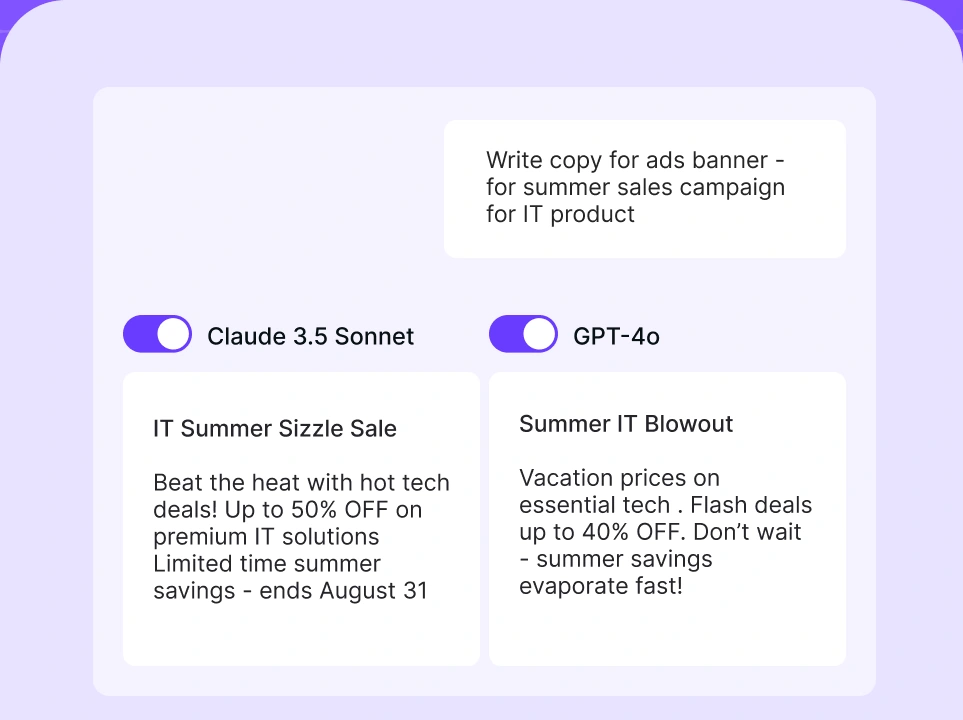
Compare AI models
Build no-code AI Agents

AI governance tools for enterprise: what changes at scale
At enterprise scale, managing a handful of experimental prototypes is fundamentally different from governing hundreds of production AI systems and autonomous agents. Enterprise AI governance tools must accommodate decentralized teams, high-volume inference streams, and diverse regulatory jurisdictions without creating technical bottlenecks.
Several critical governance challenges emerge as deployments multiply:
- Cross-functional team alignment. Enterprise governance requires active collaboration between CISOs, Chief Risk Officers, legal counsel, compliance officers, and machine learning engineers. Dedicated AI governance platforms provide customized views, enabling legal teams to review regulatory obligations while engineers monitor technical performance metrics.
- Managing hundreds of models and agents. Juggling dozens of internal models and third-party AI providers in spreadsheets quickly breaks down. Enterprise tools automate live AI inventory tracking, model inventory updates, and continuous monitoring across multi-cloud environments.
- Protecting sensitive AI data assets and AI data flows. As employees interact with generative AI, governance platforms must inspect prompts and responses to prevent sensitive data leaks, enforce data protection rules, and satisfy enterprise data governance requirements. Prompt injection and data leakage are the AI security risks that grow fastest at scale.
- Predictable cost and performance scaling. High-volume inference can lead to unexpected cloud expenses and inflated AI bills. Enterprise platforms implement Smart Routing and usage quotas to maintain budget predictability while upholding strict security controls.
How to choose the right AI governance tool
Finding the best AI governance software for your organization requires evaluating your specific risk profile, existing technology investments, and long-term AI strategy. Follow this five-step decision framework to identify the right governance tool:
- 1.Build a comprehensive AI inventory. Catalog every internal model, third-party AI integration, and experimental agent currently active across your organization.
- 2.Tier your AI assets by risk level. Classify your AI systems according to their potential impact on users, business operations, and regulatory compliance. Prioritize strict AI controls and deep impact assessments for high-risk applications.
- 3.Map specific regulatory frameworks. Identify the legal standards that apply to your industry and operating regions, including the EU AI Act, NIST AI RMF, and ISO/IEC 42001. Ensure your chosen platform provides pre-built compliance reporting and automated policy enforcement for these standards.
- 4.Evaluate security and stack integration. Verify that the governance software integrates seamlessly with your existing identity providers, SIEM platforms, DLP solutions, and model repositories. Vendor security practices matter just as much, so check certifications, data residency, and retention policies before you commit.
- 5.Ensure support for agentic and generative AI. Traditional model governance tools built solely for tabular ML cannot adequately oversee autonomous agents or multi-LLM workflows. Choose a platform that governs real-time data flows, tool execution, and multi-model routing.
Taking a structured approach ensures you select responsible AI governance tools and the best AI governance software that protects your business while accelerating innovation.
How nexos.ai supports AI governance across multiple LLMs
Most modern organizations don't rely on a single model provider. Teams leverage different LLMs and specialized agents across departments, making centralized oversight and policy enforcement essential. Operating in an AI workspace for multiple LLMs allows teams to access top models while maintaining complete organizational control.
nexos.ai supports AI governance through a unified control plane that combines enterprise security with seamless usability:
- Centralized policy enforcement. Apply consistent security controls, content filters, and data protection rules across all internal users and AI providers.
- Granular access controls and audit trails. Restrict model and tool access by department, project, or role while maintaining immutable logs of all AI usage for audit readiness.
- Live model evaluation and routing. Easily compare AI models across benchmark performance, latency, and cost, using Smart Routing to direct each query to the best-fit model automatically.
- Autonomous agent governance. Implement human-in-the-loop approval workflows for write-type actions, ensuring that autonomous agents execute sensitive tasks safely.
- Comprehensive AI security and cost tracking. Prevent sensitive data leakage into public training sets while tracking token expenditure in real time to avoid runaway AI bills.
By unifying model access, runtime safety, and observability, nexos.ai lets your teams ship AI workflows faster while keeping risk and spend fully under control.
