Table of contents
Key takeaways
- AI agents for content creation run entire workflows like research, writing, optimization, and publishing without constant input.
- Common agent types include research agents, writing agents, repurposing agents, SEO agents, and analytics agents.
- AI agents for content creation cut production time and cost while keeping brand voice consistent across large volumes.
- Factual accuracy and brand-sensitive content still need human review since AI agents can hallucinate or misjudge tone.
- nexos.ai connects AI content agents to 200-plus models and routes drafts through approval workflows teams define.
What are AI agents for content creation?
AI agents for content creation are autonomous systems that execute complete content workflows, such as research, writing, optimization, and publishing, without constant human input. They use natural language processing to support human creativity. Unlike standard AI writing tools that wait for your prompt and generate one piece at a time, agents chain tasks together: AI content agents pull competitor insights, draft three blog variants, optimize for target keywords, generate snippets, and schedule posts across platforms.
AI agents for content creation integrate AI systems with your existing marketing automation platforms to produce content at scale without compromising quality. Standard tools require you to orchestrate every step. AI agents orchestrate themselves. AI content agents run on LLMs (GPT-4, Claude, Llama) but layer planning, memory, and tool-use on top. Many platforms leverage multiple AI models simultaneously, choosing the best model for each specific task. You set the goals and guardrails once, and AI agents handle execution, learning from performance data and improving their output over time.
How do AI agents for content creation work?
AI agents for content creation operate through five connected components that turn abstract goals into published content:
- Perception: The AI agent for content creation ingests your inputs: content briefs, competitor URLs, brand guidelines, past performance metrics, and trending topics in your niche. The AI content agent analyzes structured data from your analytics tools and audience preferences from past engagement patterns. The AI content agent doesn't just read text; it interprets what success looks like for this specific task.
- Planning: The AI agent for content creation breaks your goal ("publish weekly LinkedIn posts that drive demo requests") into executable steps: analyze top-performing posts, identify common hooks, draft three variants, A/B test headlines, and schedule the winner for Tuesday, 9 am. This planning stage is where strategic thinking happens, as the AI agent doesn't just execute; it decides the optimal path based on your goals.
- Execution: The AI agent for content creation runs each step using connected tools: web search for research, writing modules for drafts, SEO analyzers for optimization, and formatting engines for platform specs. It ensures that content generation meets search engine requirements while formatting output for social media platforms' specifications. Each tool returns results that the AI content agent uses in the next step.
- Memory: It retains context across repetitive tasks. Your brand voice guidelines don't need re-uploading. Style preferences from last month's campaign inform this month's. High-performing content patterns get prioritized automatically.
- Action: Final output goes where you need it: published directly to CMS, queued in your scheduling tool, or routed to marketing for review. The AI content agent closes the loop as it doesn't just generate content and stop.
These five components work in continuous cycles, not linear sequences. Each completed task feeds data back into perception and memory, making the AI agent smarter with every piece of content it produces.
Types of AI agents for content creation
Different AI agents handle different bottlenecks in your content engine. Most teams deploy multiple agent types working in sequence. There are many real-world examples of AI agents, including those for content creation. These include the following:
Research and ideation agents
Research and ideation agents monitor your industry and competitors and analyze user behavior to surface content opportunities before your team manually hunts for them. They scan competitor blogs, Reddit threads, trending searches, and your past analytics to recommend topics with proven demand and low competition. Research and ideation agents analyze what performs well in search engines and identify gaps where your expertise can rank. Output: ranked topic lists with search volume, competitor gap analysis, and suggested angles.
Writing and drafting agents
Writing and drafting agents generate first drafts. Not placeholder text, but structured, on-brand content ready for human refinement. You feed them topic briefs, target keywords, and voice examples. They produce long-form content, social media posts, YouTube content, blog articles, video content, product descriptions, email sequences, or ad copy that match your style guidelines.
Content repurposing agents
One webinar becomes ten assets: a blog post, a LinkedIn carousel, a Twitter thread, an email newsletter, and a ready-to-present deck spun up with an AI slide generator. Repurposing agents extract key points from source content and reformat for each platform's constraints and audience expectations. They preserve your core message while adapting tone, length, and structure per channel.
SEO optimization agents
SEO optimization agents don't just insert keywords. SEO agents analyze SERP intent, competitor content depth, and ranking factors to restructure drafts for search visibility. SEO optimization agents suggest header hierarchies, internal linking opportunities, meta descriptions, and content gaps your draft needs to fill. Output: SEO recommendations with implementation priority and expected impact.
Analytics and performance agents
Analytics and performance agents close the feedback loop. They track which headlines drive clicks, which CTAs convert, and which content ideas and formats retain readers. Then analytics and performance agents feed performance data back into writing agents to improve future output. Over time, your content system learns what works for your specific audience, not generic best practices.

Build no-code AI Agents in minutes
Move from chatting with AI to getting things done.
Chat with leading AI models
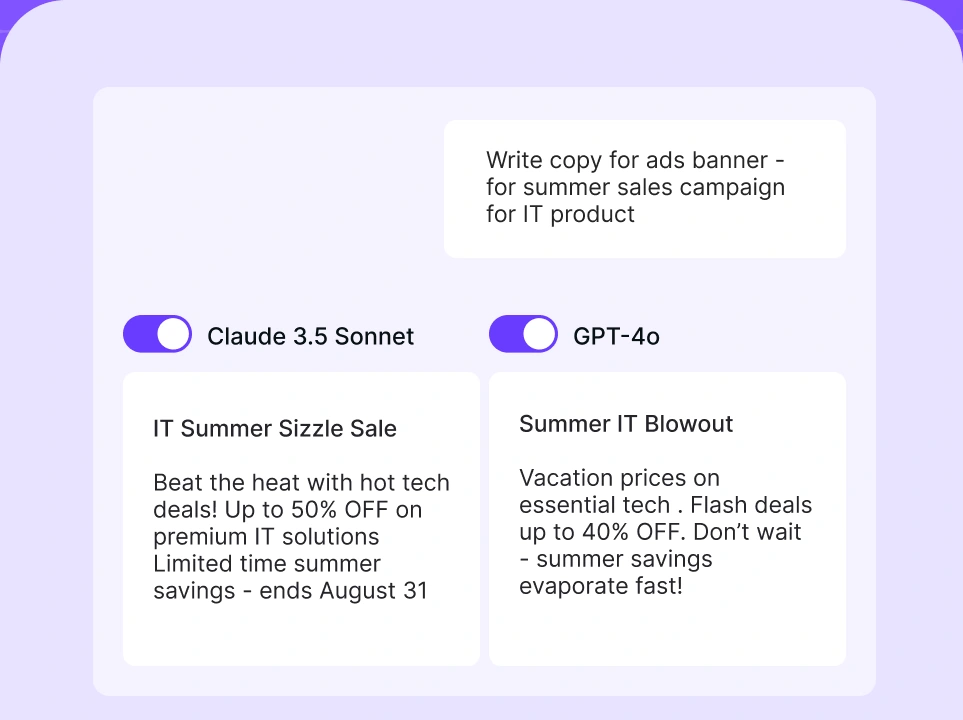
Compare AI models
Build no-code AI Agents

Key benefits of using AI agents for content creation
AI agents are no longer just a tool. These AI tools for content creation deliver value beyond faster typing. Their AI capabilities deliver value beyond faster typing. Agentic AI restructures how content teams allocate time, maintains consistent quality, and scales output without proportional growth in headcount.
Faster content production
Production time drops on repeatable content types. A blog post that took six hours (research, outline, draft, editing, formatting) now takes minutes. The AI agent for the content creation process handles the first four steps, and the human refines the draft. Teams publishing 4 posts monthly scale to 15+ without adding writers. Speed advantage compounds with AI productivity tools for content teams: faster iteration means faster learning about what resonates.
Consistency at scale
Brand identity and voice don't drift when you're producing 50 pieces monthly across five writers. AI agents for content creation apply the same style guide, terminology, and structural patterns to every output. New team members onboard faster, and they refine AI content agent drafts instead of learning voice from scratch. Consistency extends to posting schedules: AI agents don't miss deadlines, forget platform specs, or deprioritize content ideas.
Smarter content personalization
AI agents segment and customize at volumes humans can't match. Same core message, ten audience variants: SaaS prospects get ROI-focused case studies, enterprise buyers get compliance documentation, developers get technical integration guides. With AI for marketing automation, personalization happens in minutes, not days. Performance data feeds back into segmentation logic, and AI content agents learn which variants work for which segments.
Lower cost per piece of content
Fixed AI content agent cost spreads across growing output volume. Agency rates of $500–2000 per article become agent costs of $50–200 (LLM usage + platform fees + human review time). ROI improves as volume scales, breaking even at 20 pieces per month.
Challenges and limitations to keep in mind
AI content agents solve execution bottlenecks but introduce new governance and quality challenges. Most implementation failures come from treating AI content agents as zero-oversight systems instead of high-leverage tools requiring clear boundaries.
- Factual accuracy isn't guaranteed: AI content agents hallucinate statistics, misattribute quotes, and confidently state outdated information. Every claim touching compliance, health, finance, or brand reputation needs human verification. AI content agents excel at structure and flow; they're unreliable historians.
- Brand-sensitive content requires human judgment: Tone-deaf phrasing, culturally insensitive examples, and off-brand humor slip through when AI content agents optimize for engagement metrics alone. Crisis communications, executive messaging, and customer apologies should route through experienced writers, not AI-generated drafts.
- Context window limits affect long-term projects: AI content agents lose coherence across 10,000+ word guides or multi-chapter content. They forget earlier sections, repeat points, or contradict themselves. Best for discrete pieces under 3,000 words; longer work needs human assembly of agent-generated sections.
- Integration complexity scales with tool count: Connecting AI content agents to your Content Management Systems (CMS), analytics platform, SEO optimization tools, and scheduling software requires API setup, authentication management, and ongoing maintenance. Each integration point is a potential failure point with a few hours of setup per connected AI tool.
- Over-optimization for metrics can hurt brand: AI content agents chasing click-through rates produce clickbait. AI content agents chasing keyword density produce robotic prose. Pure metric optimization without brand guardrails degrades AI-generated content quality over time. You need human oversight to define what "good" means beyond numbers.
The agents are autonomous content teammates: they receive assignments, plan execution, use the right AI tools for each step, remember your preferences, and deliver finished work to your workflow.
How to get started with AI agents for content creation
Most teams overthink implementation and underthink preparation. The path to successful agent deployment isn't complex, but sequential.
- 1.Audit your current content workflow: Track where your team spends time across a two-week sprint. If research consumes 8 hours weekly, start there. If first-draft writing is the bottleneck, automate that. If repurposing blocks you from multi-channel distribution, solve repurposing first. Deploy AI content agents where pain is sharpest, and ROI is clearest.
- 2.Define your brand guidelines clearly: Agents for content creation perform best with explicit rules. Document tone-of-voice principles with 10+ examples of approved vs rejected phrasing. Specify forbidden topics, required disclosures, terminology preferences, and formatting standards. Vague guidelines ("sound professional") produce generic output. Precise guidelines ("use active voice, second person, sentences under 20 words") produce on-brand content.
- 3.Start with one use case: Don't automate end-to-end on day one. Pick one repeatable, low-risk AI-generated content type: social media content creation, product descriptions, newsletter summaries, or blog outlines. Many teams begin with no-code AI agents for marketing that handle these tactical tasks without requiring developer resources. Prove that the AI agent saves time and maintains quality before expanding the scope. Early wins build organizational trust; early failures kill momentum.
- 4.Set up human review checkpoints: Every AI content agent output needs a human decision point before publication. Junior team members can review formatting and brand voice. Senior team members review factual claims and strategic messaging. Define review SLAs (24-hour turnaround for blog posts, 2-hour for social) so AI agents don't create new bottlenecks.
- 5.Monitor and iterate: Track AI content agent performance weekly: output volume, review rejection rate, time saved, and content engagement metrics. Use performance data integration to refine prompts, adjust guardrails, and expand successful use cases. AI content agents improve through feedback loops. If you're not measuring and iterating, you're leaving the potential value unrealized.
Follow this sequence, and you'll see measurable time savings within two weeks. Skip steps or rush the entire process, and you'll spend months troubleshooting avoidable quality issues.
How nexos.ai supports AI agents for content creation
nexos.ai is an all-in-one AI platform for business and provides the control layer organizations need to deploy AI content agents without sacrificing governance. A single dashboard manages which models your AI content agents access, what data they can process, and who reviews output before publication. IT sets AI controls once, such as approved AI tools, usage limits, and data handling policies. Marketing teams immediately build and run nexos.ai agents for content creation within those boundaries.
Your AI content agents connect to 200+ AI models, access your brand guidelines automatically, and route drafts through approval workflows you define. Usage tracking shows which AI content agents deliver ROI, which need refinement, and where your content budget actually goes.